

 See My Latest Article on HelloNation
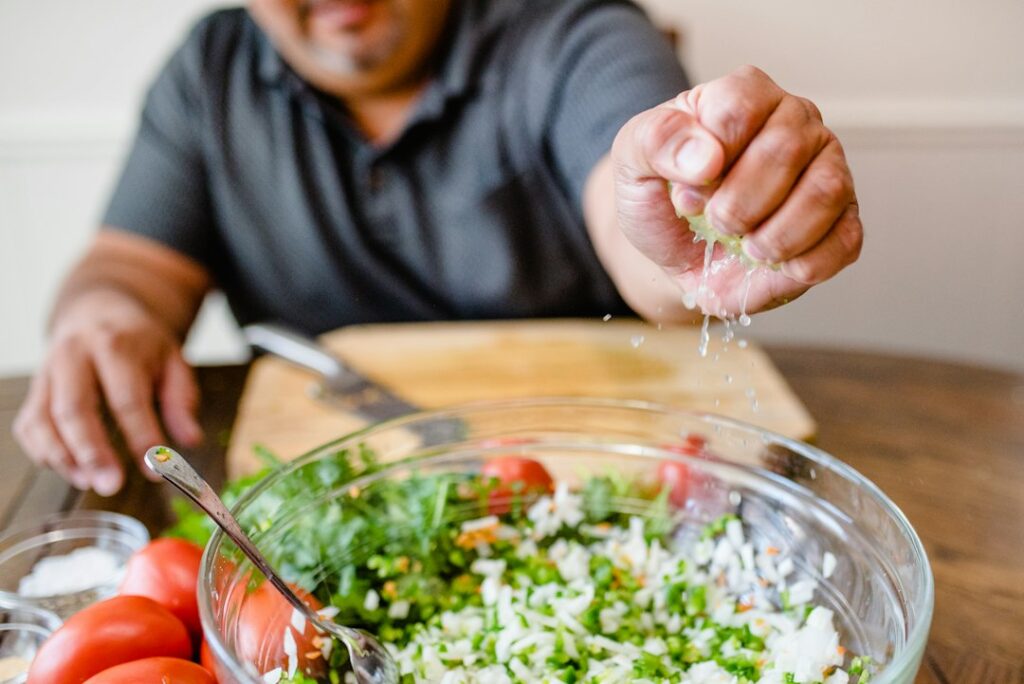
Learning Hebrew through cooking can make vocabulary easier to remember because words are connected to actions, smells, textures, and familiar routines. For residents of Englewood, NJ, Israeli recipes also provide a practical way to explore everyday language while preparing foods that fit family kitchens, shared meals, and seasonal cooking habits.
Why does cooking help with Hebrew learning?
Cooking turns language practice into a sequence of meaningful tasks. Instead of memorizing isolated words, learners hear and use Hebrew while washing, cutting, mixing, heating, tasting, and serving.
A simple recipe naturally introduces several types of vocabulary:
- Ingredients: עגבנייה (*agvaniyah*, tomato), מלפפון (*melafefon*, cucumber), בצל (*batzal*, onion), שום (*shum*, garlic)
- Actions: לחתוך (*lachtokh*, to cut), לערבב (*le’arev*, to mix), להוסיף (*lehosif*, to add), לבשל (*levashel*, to cook)
- Descriptions: חם (*kham*, hot), קר (*kar*, cold), מתוק (*matok*, sweet), חריף (*kharif*, spicy)
- Kitchen objects: סכין (*sakin*, knife), קערה (*ke’arah*, bowl), סיר (*sir*, pot), כף (*kaf*, spoon)
The physical action gives each word a clear reference. Saying “add the lemon” while adding lemon juice creates a stronger memory than copying the word from a vocabulary list.
Which Israeli recipes are suitable for beginners?
Recipes with short ingredient lists and repeated actions are usually the most useful for early learners. The goal is not culinary complexity. It is repeated, understandable Hebrew.
Israeli salad
Israeli salad is a strong starting point because the preparation is straightforward and the ingredients are easy to identify. A learner can practice the names of vegetables, colors, quantities, and cutting instructions.
Useful phrases include:
- חותכים את העגבניות — Cut the tomatoes.
- מוסיפים מלפפון — Add cucumber.
- מערבבים היטב — Mix well.
- מוסיפים מעט מלח — Add a little salt.
This recipe also helps learners notice Hebrew’s use of definite articles. The word את often appears before a specific direct object, as in “cut the tomatoes.”
Hummus
Hummus introduces food vocabulary, measurements, and texture words. A basic preparation may involve chickpeas, tahini, lemon juice, garlic, salt, and water.
Possible terms include:
- חומוס — chickpeas or hummus, depending on context
- טחינה — tahini
- לימון — lemon
- מלח — salt
- מים — water
- חלק — smooth
- סמיך — thick
- דליל — thin
Hummus is also useful for practicing taste preferences. Learners can ask, “Is it too salty?” or “Do you want more lemon?” These short exchanges make the language immediately usable at the table.
Shakshuka
Shakshuka provides practice with cooking verbs and sequence words. Because the dish develops in stages, it supports phrases such as “first,” “then,” and “after that.”
- קודם — first
- אחר כך — afterward or then
- עכשיו — now
- בסוף — finally
A learner might describe the process in simple Hebrew: “First, fry the onion. Then add the tomatoes. Finally, add the eggs.” Even limited vocabulary can produce a complete explanation.
How should a Hebrew learner use a recipe?
A recipe can be used in three stages: before cooking, during preparation, and after the meal.
Before cooking
Choose five to ten words rather than trying to translate every line. Write each word in Hebrew, add a pronunciation guide, and include its English meaning. Reading the Hebrew script is valuable, but pronunciation support can reduce frustration for beginners.
A useful preparation list might contain:
- the ingredients
- three cooking verbs
- two measurements
- two taste or texture words
- one question
For example, a learner preparing salad might study “tomato,” “cucumber,” “cut,” “mix,” “a little,” “a lot,” and “Is it ready?”
During cooking
Use short commands and descriptions. Speaking slowly is acceptable. Repetition matters more than speed.
A person cooking alone can narrate each action:
- אני חותך — I am cutting, traditionally used by a male speaker
- אני חותכת — I am cutting, traditionally used by a female speaker
- אני מוסיף — I am adding, traditionally used by a male speaker
- אני מוסיפה — I am adding, traditionally used by a female speaker

Hebrew verbs often change according to gender and tense. Beginners do not need to master every form immediately, but cooking provides a natural setting for noticing these patterns.
After eating
Use the meal to practice opinions and descriptions:
- טעים — tasty
- טעים מאוד — very tasty
- אני אוהב — I like it, traditionally used by a male speaker
- אני אוהבת — I like it, traditionally used by a female speaker
- אני לא אוהב — I do not like it, traditionally used by a male speaker
- אני לא אוהבת — I do not like it, traditionally used by a female speaker
Learners can also describe what they would change next time: less salt, more lemon, a smoother texture, or a spicier flavor.
What Hebrew language points can cooking teach?
Cooking is particularly helpful for practicing imperatives, numbers, gender agreement, and sentence order.
Recipe instructions often use commands such as “cut,” “add,” “mix,” and “wait.” Numbers appear in measurements, timing, and portions. Hebrew nouns have grammatical gender, so adjectives and some verb forms must agree with them.
Cooking also introduces the difference between spoken and written language. A recipe may use formal or concise wording, while family conversations often use shorter, more casual expressions. Comparing the two helps learners understand that everyday Hebrew is not always identical to textbook Hebrew.
The kitchen also provides repeated exposure to prepositions. Learners encounter phrases meaning “in the bowl,” “with a spoon,” “on the table,” and “into the pot.” These small words are easy to overlook but essential for natural speech.
How can families practice together?
A family does not need to speak only Hebrew for the activity to be effective. A gradual approach works better for many households.
One person can read the ingredient names in Hebrew while another prepares them. A child may label objects with Hebrew words. Adults can ask simple questions, such as:
- מה זה? — What is this?
- כמה? — How much?
- מוכן? — Is it ready?
- אפשר עוד? — Can I have more?
- איפה הסכין? — Where is the knife?
For mixed-level households, each person can have a different task. Beginners may identify ingredients, intermediate learners may give instructions, and more advanced speakers may explain the recipe or discuss its variations.
Cooking together can also support heritage learning. Family members may share how a dish is prepared in their household, what occasions it is associated with, or which Hebrew expressions relatives use around meals.
How can local conditions shape the activity?
In Englewood, seasonal weather and household routines may affect when and how families cook. Cold winter days can make warm dishes such as shakshuka or lentil soup especially practical, while summer may favor salads, chilled dips, and meals prepared without extended oven use.
Homes and apartments may also differ in kitchen size, ventilation, storage, and access to outdoor cooking space. Recipes can be adapted without losing their language value. A learner can practice the same verbs with a stovetop, compact kitchen, or shared family workspace.
The most useful setup is one that makes conversation possible. A small recipe prepared slowly can provide more Hebrew practice than a complicated meal that leaves everyone focused on timing.
What common mistakes should beginners avoid?
The biggest mistake is treating cooking as a vocabulary test. Learners do not need to know every ingredient or grammar rule before beginning. Repeated use of a small number of words is more productive.
Another common problem is relying only on English pronunciation. Transliteration can help at first, but reading Hebrew letters should gradually become part of the activity. Learners should also expect mistakes with gender, verb endings, and pronunciation. Correcting one or two recurring errors is usually more useful than interrupting every sentence.
Finally, recipes should not be treated as fixed cultural rules. Israeli cooking includes many regional, family, and historical influences. Preparing a dish in a particular way can open a language discussion without suggesting that there is only one authentic version.
A bowl of salad, a pot of shakshuka, or a plate of hummus can become a compact Hebrew lesson. The ingredients create concrete vocabulary, the preparation supplies repeated verbs, and the shared meal gives learners a reason to communicate.