

 See My Latest Article on HelloNation
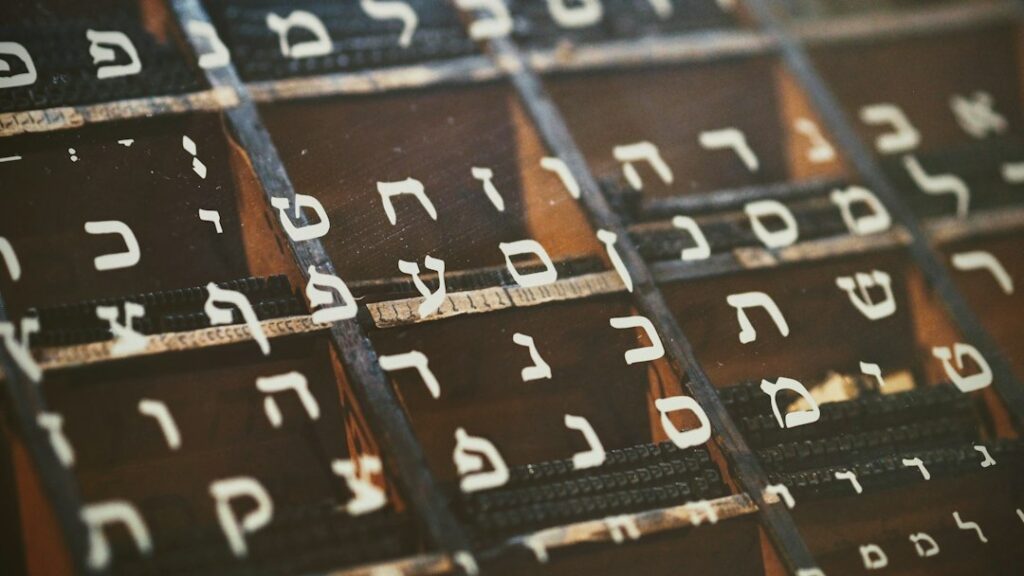
Hebrew letters are more than symbols used to record words. Each letter has a sound, a written form, a place in the alphabet, and a role in Jewish religious, cultural, and historical traditions. For residents of Englewood, NJ, learning about these letters can make prayer books, holiday materials, family names, inscriptions, and Hebrew lessons easier to understand.
What makes Hebrew letters different from English letters?
Hebrew is written from right to left, and its alphabet contains 22 basic letters. Unlike English, Hebrew does not use separate uppercase and lowercase forms. The same letter appears in a word whether it begins a sentence, appears in the middle, or comes at the end.
Hebrew letters primarily represent consonants. Vowel sounds are often understood from context or shown with small marks called *nikkud*. These marks appear above, below, or inside the letters and are especially useful for beginners, children, prayer reading, poetry, and biblical Hebrew.
For example, the letter ב can represent a “b” sound or a “v” sound, depending on the vowel marking and the word. The letter ש may represent either “sh” or “s,” depending on the dot placed above it.
This means that reading Hebrew involves more than memorizing symbols. Learners gradually connect each letter with its shape, sound, position in a word, and possible pronunciation.
What are the names and sounds of the Hebrew letters?
The traditional Hebrew alphabet is commonly listed in this order:
- א — Alef
- ב — Bet
- ג — Gimel
- ד — Dalet
- ה — He
- ו — Vav
- ז — Zayin
- ח — Het
- ט — Tet
- י — Yod
- כ — Kaf
- ל — Lamed
- מ — Mem
- נ — Nun
- ס — Samekh
- ע — Ayin
- פ — Pe
- צ — Tsadi
- ק — Qof
- ר — Resh
- ש — Shin
- ת — Tav
Some letters have a different written form when they appear at the end of a word. These are called final forms:
- כ becomes ך
- מ becomes ם
- נ becomes ן
- פ becomes ף
- צ becomes ץ
The final form does not create a new sound. It signals that the letter comes at the end of a word. Recognizing these forms is an essential step for anyone learning to read Hebrew comfortably.
Do Hebrew letters have meanings beyond their sounds?
Yes, but those meanings should be understood in context. In ordinary Hebrew reading and writing, letters function mainly as parts of words. In Jewish commentary, mysticism, poetry, and educational traditions, individual letters may also be associated with numbers, ideas, images, or spiritual themes.
For instance, *aleph* is often connected with beginnings, unity, or quiet strength because it usually has no independent vowel sound. *Bet* is associated in traditional interpretation with a house, partly because the word *bayit*, meaning “house,” begins with that letter. *Lamed* is linked with learning because it appears in words related to study.
These associations are interpretive rather than universal dictionary definitions. A learner should not assume that every Hebrew word can be understood by adding together symbolic meanings of its letters. Hebrew vocabulary depends on roots, grammar, pronunciation, and historical usage.
Why are some Hebrew letters also numbers?
In traditional Hebrew numbering, letters can represent numerical values. This system is known as *gematria*. The first ten letters generally represent numbers one through ten, later letters represent larger values, and certain final forms may be assigned higher values in some systems.
Gematria appears in dates, inscriptions, religious commentary, and cultural references. It can be interesting for students because it shows how writing, mathematics, and interpretation have sometimes overlapped.

However, numerical values are not normally needed to read everyday Hebrew. Beginners benefit from first learning letter recognition, sounds, vowel patterns, and basic word structure before studying numerical symbolism.
Why do Hebrew letters look different in books, handwriting, and decorative writing?
Hebrew has several visual styles. Printed Hebrew, often called square script, is used in books, educational materials, prayer texts, and many formal settings. Handwritten Hebrew uses more flowing forms that may look quite different from printed letters.
Calligraphic styles can vary further, particularly in religious texts, artwork, historic manuscripts, and ceremonial objects. Decorative lettering may emphasize shape and balance rather than make every feature easy for a beginner to identify.
This variation can be confusing when learners first encounter handwritten notes or informal materials. A useful approach is to master printed letters first, then compare each one with its handwritten counterpart. The goal is not to memorize every artistic style, but to recognize the essential features that remain consistent.
What is the connection between Hebrew letters and Jewish tradition?
Hebrew letters are closely connected with Jewish prayer, the Torah, holiday observance, names, and historical records. Many familiar terms remain recognizable even when they are written in English transliteration. Seeing the original Hebrew can reveal patterns that transliteration sometimes hides.
The letters also carry a strong sense of continuity. They appear in ancient inscriptions, medieval manuscripts, modern books, family documents, classroom materials, and contemporary Israeli writing. For families and adult learners in a diverse community such as Englewood, studying the alphabet can support religious education, cultural understanding, family connection, or personal curiosity.
Different Jewish communities may pronounce certain letters differently. For example, the letter ת may be pronounced with or without a “th” quality in particular traditions, and the letter ח may sound stronger or softer depending on the speaker’s background. These differences reflect living pronunciation traditions rather than mistakes.
What should beginners learn first?
A practical learning sequence is more effective than trying to memorize every symbolic association at once.
Start with:
- The names and shapes of the 22 letters
- The five final forms
- Right-to-left direction
- Common consonant sounds
- Basic vowel marks
- Short, familiar words
- The difference between printed and handwritten forms
Writing the letters by hand can help learners remember their structure. It is also useful to practice letters in groups that are easy to confuse, such as ד and ר, ב and כ, or ה and ח.
Reading aloud supports pronunciation, while copying short words reinforces direction and spacing. Learners should also expect some sounds to feel unfamiliar, particularly ח and ע. Pronunciation improves through repeated listening and practice rather than through English spelling comparisons alone.
What are common misunderstandings about Hebrew letters?
One common misunderstanding is that every letter has one fixed English equivalent. Transliteration systems differ, so the same Hebrew letter may be represented in more than one way.
Another misconception is that Hebrew letters are pictographs whose original pictures always explain modern meanings. Some early letter shapes may have historical connections to ancient writing systems, but modern Hebrew words cannot generally be decoded through pictures.
It is also inaccurate to treat symbolic interpretations as the same thing as standard Hebrew grammar. Symbolism can enrich study, but reading fluency depends on recognizing letters, sounds, word patterns, and sentence structure.
How can local learners make study practical?
A steady routine works well in a home or classroom setting, especially during the school year or before holidays when Hebrew materials become more visible. Short practice sessions can include reading a few words from a children’s book, identifying letters in a prayer passage, or writing a family name in Hebrew with guidance from a reliable learning resource.
Households can also compare printed text with handwritten examples and discuss pronunciation differences respectfully. In a community with varied religious and cultural backgrounds, the same alphabet may be studied for several reasons: literacy, heritage, worship, language learning, genealogy, or appreciation of Jewish history.
The most useful goal is not to assign a mystical meaning to every character. It is to understand how the letters work while appreciating the historical and cultural depth they carry.