

 See My Latest Article on HelloNation
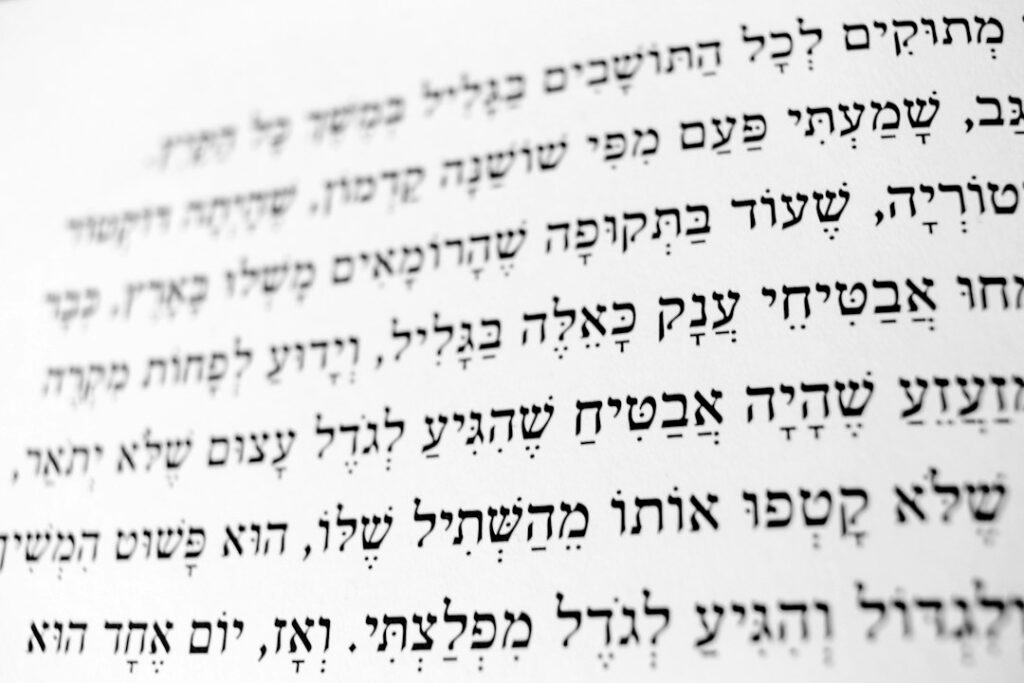
Why can Hebrew be read without vowels?
In Englewood, NJ, learners often encounter Hebrew text without the small vowel marks known as *niqqud*. This is normal rather than incomplete printing. Modern Hebrew newspapers, novels, websites, public notices, many prayer books, and most everyday writing usually rely on consonants and context instead of showing every vowel.
Hebrew is written mainly with consonants. The vowel system is added through marks placed above, below, or inside the letters, but fluent readers gradually learn to recognize common words without needing those marks.
For beginners, this can feel similar to seeing English words with many letters removed. With practice, however, unvocalized Hebrew becomes predictable because spelling patterns, word families, grammar, and context work together.
What are niqqud, and when are they used?
*Niqqud* are a system of vowel and pronunciation marks developed to clarify how Hebrew words should be read. They are especially common in:
- Children’s books and beginner textbooks
- Biblical and traditional religious texts
- Dictionaries and language-learning materials
- Poetry and instructional materials
- Words whose pronunciation might otherwise be unclear
Adult readers usually encounter fewer vowel marks as their skills advance. A learner may first study the word מֶלֶךְ, pronounced *melekh*, meaning “king,” and later see the same word written as מלך.
The consonants remain, but the reader supplies the pronunciation from experience and context.
How do Hebrew readers know which vowels to use?
Readers use several clues at the same time. No single clue solves every word, but together they make reading much easier.
Recognize familiar word shapes
Many Hebrew words follow recurring patterns. Once a learner knows a word such as כתב, connected forms become easier to identify:
- כָּתַב — he wrote
- כּוֹתֵב — writing or writes
- מִכְתָּב — letter
- כְּתִיבָה — writing
The exact vowel pattern may change, but the shared consonants help reveal the connection. Studying related words is usually more useful than memorizing isolated vocabulary lists.
Learn common prefixes and suffixes
Short letters attached to a word often carry grammatical meaning. Common prefixes include:
- ו־ — and
- ה־ — the
- ב־ — in or with
- ל־ — to or for
- מ־ — from
- כ־ — like or as
For example, the word בית means “house.” The form בבית can mean “in the house,” while לבית can mean “to the house.” Recognizing the attached prefix prevents the word from looking unfamiliar.
Common suffixes also provide clues. A final ם may appear in a plural masculine ending, and a final ה can sometimes signal a feminine noun or a grammatical ending. These patterns are not absolute, but they are useful reading signals.
Which Hebrew letters cause the most confusion?
Several letters deserve special attention because their sound or position can be unfamiliar to English speakers.
א, ע, ה, and ח may be difficult because Hebrew distinguishes sounds that English often treats differently or does not use regularly. In modern Israeli pronunciation, א and ע are frequently silent or lightly pronounced, while ח usually has a throaty sound.
Final letters also require practice. Five Hebrew letters change shape when they appear at the end of a word:
- כ becomes ך
- מ becomes ם
- נ becomes ן
- פ becomes ף
- צ becomes ץ
These are not new letters. They are final forms of familiar letters. Learning them early helps prevent unnecessary pauses during reading.
The letter ו can represent several sounds, depending on the word. It may function as a consonant, or help indicate an “o” or “u” sound. The letter י can similarly represent a consonant or help signal an “i” or “e” sound. Context determines the correct reading.
What is the most effective practice method?
The most productive routine combines fully vocalized text with ordinary unvocalized text. Start by reading a short passage with niqqud. Then cover the vowel marks or find the same passage without them and try to read it again.
A useful five-step process is:
1. Read the word with vowels.
2. Say the word aloud and identify its meaning.
3. Examine its consonants and any attached prefixes or suffixes.
4. Read it again without looking at the vowel marks.
5. Place the word in a short sentence.
Short, repeated practice is more effective than trying to read a long page all at once. A few lines from a children’s story, prayer, personal message, or simple news item can provide enough material for a productive session.
For residents balancing study with work, school schedules, or seasonal indoor routines, ten to fifteen focused minutes several times a week may be easier to maintain than one long weekly session.

Should learners sound out every word?
Not always. Sounding out every letter can be helpful at the beginning, but advanced reading depends on recognizing words as units.
If a familiar word appears, try to identify it before analyzing each letter. If the word is unfamiliar, inspect the root, prefixes, suffixes, and sentence meaning. This two-step approach is faster:
- First, ask: “Does this word look familiar?”
- Then, if needed, ask: “What grammatical clues can help decode it?”
Reading too slowly can make a sentence harder to understand because the reader forgets the beginning before reaching the end. The goal is not to guess carelessly, but to combine visual recognition with grammatical reasoning.
How does context change the pronunciation?
Hebrew spelling without vowels can sometimes represent more than one possible reading. Context usually resolves the uncertainty.
For example, ספר can refer to a “book,” a “school,” or a verb related to counting or telling, depending on the vowels and sentence. The surrounding words reveal which meaning fits.
A learner should examine:
- The words before and after the unknown term
- Whether the sentence is describing a person, object, or action
- The tense and grammatical form
- The topic of the passage
- Familiar root patterns
This is why vocabulary and grammar support reading so strongly. Memorizing pronunciation without understanding sentence structure provides only limited help.
What common mistakes should be avoided?
A frequent mistake is assuming that every Hebrew letter must have a separate spoken sound. Hebrew spelling often includes letters that help indicate vowels, especially ו and י. These letters may not be pronounced in the same way in every word.
Another mistake is treating every word as completely new. A learner may know the root or base word but fail to recognize it after a prefix is attached. Separating the word into parts can make it more familiar.
It is also easy to rely too heavily on English pronunciation habits. Hebrew has its own sound system, syllable patterns, and stress rules. Listening to clear spoken Hebrew while reading can help connect spelling with natural pronunciation.
Finally, readers should expect occasional ambiguity. Even fluent speakers use context, grammar, and prior knowledge to interpret unvocalized text. Difficulty with an unfamiliar word does not mean the reading method has failed.
How can families and adult learners build confidence?
Keep reading materials close to the learner’s actual interests. Someone interested in family correspondence may benefit from short messages and personal narratives. Another learner may prefer recipes, simple stories, cultural articles, or familiar prayers.
A small notebook can track:
- New words seen without vowels
- Their fully vocalized forms
- Related words from the same root
- Prefixes or suffixes attached to them
- A short example sentence
Progress is easier to notice when learners revisit the same words over time. Reading aloud, even privately, also helps connect visual patterns with pronunciation.
The central skill is not memorizing every possible vowel pattern. It is learning to use consonants, word structure, grammar, and context together. With steady exposure, unvocalized Hebrew becomes less like a code to decode and more like an ordinary writing system that the reader can recognize directly.